
Clinical Library · Hormonal & Metabolic Health
The liver–PCOS connection: the organ most PCOS plans ignore
Most PCOS plans in India stop at the ovary. Inositol, maybe berberine, maybe metformin. But the same insulin signal that pushes the ovary to make more androgens also pushes the liver to store fat — and the liver is where circulating hormone by-products are prepared for exit. When that step is sluggish and the gut recirculates what should have left, the loop keeps feeding itself. That is why fatty liver and PCOS turn up together so often, and why inositol alone often plateaus.
One root cause, two organs
Non-alcoholic fatty liver disease is reported substantially more often in women with PCOS than in matched women without it, and the association holds in lean women too. The link is not weight — it is insulin. Hyperinsulinaemia simultaneously raises ovarian androgen output and drives fat synthesis inside liver cells. One upstream problem, two very different-looking sets of symptoms.
This is also why so many women describe the same frustrating picture: cycles that will not settle, stubborn jawline breakouts, heaviness after meals, and a tiredness that sleep does not fix. Those are not four unrelated complaints. They are four views of one loop.
The six-step loop
Insulin resistance rises
Cells stop hearing insulin, so the pancreas sends more. High circulating insulin is the engine of PCOS, not a side effect of it.
The ovary responds
Theca cells read high insulin as a signal to produce more androgens. Cycles lengthen, ovulation becomes unreliable, jawline acne and hair changes follow.
The liver stores fat
The same insulin signal pushes the liver toward de novo lipogenesis. Fat accumulates in liver cells — often silently, and often in women with a normal BMI.
Clearance slows
A fat-loaded liver is a busy liver. Phase I and Phase II conjugation of hormone by-products competes with everything else it is processing.
The gut recirculates
Conjugated by-products leave through bile into the gut. When the microbiome is imbalanced, some are de-conjugated and reabsorbed instead of leaving.
The loop closes
More circulating hormone load, more skin and cycle symptoms, more inflammation, and back to step one. Treating only the ovary leaves four steps untouched.
Why hormonal acne is often a clearance story
Hormone by-products are made water-soluble by the liver in two phases, then escorted out through bile into the gut. If that conjugation step is running behind, or if gut bacteria de-conjugate the package and send it back into circulation, the body carries a higher load for longer. In practice, women searching for hormonal acne supplements are usually looking at the end of this chain, not the start of it.
Nothing here replaces dermatology, and no supplement clears acne on a schedule. But it explains why a skin routine alone can stall while the metabolic and clearance side is untouched.
PCOS fatigue, cortisol and the magnesium link
The third piece runs at night. Chronically elevated evening cortisol raises glucose, makes falling asleep harder, and leaves you less insulin-sensitive the following day. Magnesium is a cofactor in both insulin signalling and the stress response, and low magnesium status is common in women with PCOS.
This is the honest framing for magnesium for PCOS: it is not a hormone treatment. It supports sleep quality, cramps and evening restlessness — and better sleep is one of the most reliable levers on next-day insulin sensitivity. That is the mechanism behind a lot of what people describe as PCOS fatigue.
Why inositol alone is rarely enough
What inositol does
Myo and D-chiro inositol at the 40:1 ratio restore the insulin second-messenger signal inside the cell. This is the foundation, and it is the piece with the strongest PCOS trial evidence.
What it does not do
It does not speed up Phase II conjugation in the liver, it does not change the gut microbiome that recirculates by-products, and it does not lower evening cortisol.
Where berberine fits
Berberine HCl activates AMPK, with effects on insulin, lipids and androgens studied in PCOS and in fatty liver. Searches for berberine for PCOS are usually looking for this second lever.
Where liver and gut actives fit
Silymarin, NAC and probiotics support the clearance and microbiome side of the loop rather than the ovarian side. Different job, same loop.
Where magnesium fits
Evening magnesium bisglycinate supports sleep and muscle relaxation without the laxative effect of cheaper forms, closing the 24-hour circle.
A 24-hour shape, not a pile of bottles
Morning, with food
Inositol at the 40:1 ratio with berberine and active folate. The metabolic foundation for the day.
During the day, with food
Liver and gut actives — liposomal silymarin, NAC, probiotics. Liver Biome+ is two tablets daily, together or divided across the day.
Evening
Magnesium bisglycinate for sleep quality and muscle relaxation, so tomorrow starts from a better place.
Spacing matters more than stacking. Take overlapping minerals into account across your whole routine, not per bottle.
The lifestyle base under all of it
- Strength train 3× a week. Muscle is the largest insulin-sensitive tissue you have, and it is the fastest lever on the loop.
- 25–35 g protein per meal. Blunts glucose spikes and steadies the cravings that keep insulin high.
- Protect 7.5 hours of sleep. A single short night measurably worsens insulin sensitivity the next day.
- Keep alcohol low. It adds directly to liver load and raises androgens.
Match the routine to the part of the loop you feel most
There is no single right answer. Start where your own symptoms are loudest, and give it months rather than weeks.
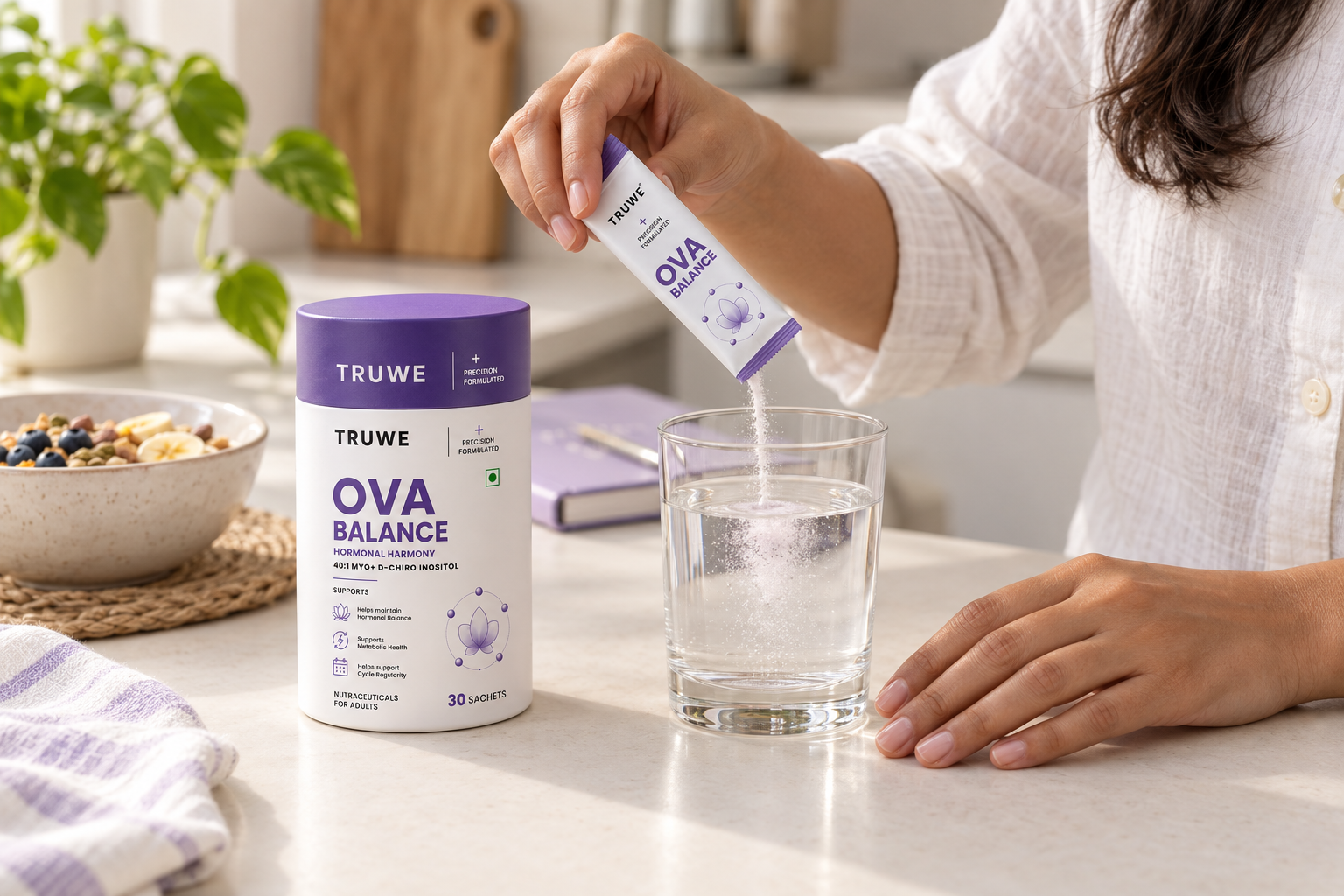
Ova Balance contains berberine and is not a prenatal routine. Speak to your clinician before starting if you are pregnant, breastfeeding, trying to conceive, or taking glucose-lowering medicines.
References
Every in-text claim in this article is credited to the original researchers and peer-reviewed journal below. Key studies cited: Unfer V et al. (2017, Endocrine Connections); Facchinetti F et al. (2015, European Journal of Obstetrics & Gynecology and Reproductive Biology); Lan J et al. (2015, Journal of Ethnopharmacology); Younossi ZM et al. (2016, Hepatology); Abenavoli L et al. (2018, Phytotherapy Research); Tilg H et al. (2022, Cell Metabolism).
- [1]
Myo-inositol effects in women with PCOS: a meta-analysis of randomized controlled trials
- Author(s)
- Unfer V, Facchinetti F, Orrù B, Giordani B, Nestler J
- Year
- 2017
- Journal
- Endocrine Connections
- Citation
- Unfer V, Facchinetti F, Orrù B, Giordani B, Nestler J. Myo-inositol effects in women with PCOS: a meta-analysis of randomized controlled trials. Endocr Connect. 2017;6(8):647-658.
- PubMed
- https://pubmed.ncbi.nlm.nih.gov/29042448/
- [2]
Results from the International Consensus Conference on myo-inositol and d-chiro-inositol in obstetrics and gynecology
- Author(s)
- Facchinetti F, Bizzarri M, Benvenga S, D'Anna R, Lanzone A, Soulage C, et al.
- Year
- 2015
- Journal
- European Journal of Obstetrics & Gynecology and Reproductive Biology
- Citation
- Facchinetti F, Bizzarri M, Benvenga S, et al. Results from the International Consensus Conference on myo-inositol and d-chiro-inositol in obstetrics and gynecology. Eur J Obstet Gynecol Reprod Biol. 2015;195:72-76.
- PubMed
- https://pubmed.ncbi.nlm.nih.gov/26479442/
- [3]
Meta-analysis of the effect and safety of berberine in the treatment of type 2 diabetes mellitus, hyperlipemia and hypertension
- Author(s)
- Lan J, Zhao Y, Dong F, Yan Z, Zheng W, Fan J, Sun G
- Year
- 2015
- Journal
- Journal of Ethnopharmacology
- Citation
- Lan J, Zhao Y, Dong F, et al. Meta-analysis of the effect and safety of berberine in the treatment of type 2 diabetes mellitus, hyperlipemia and hypertension. J Ethnopharmacol. 2015;161:69-81.
- PubMed
- https://pubmed.ncbi.nlm.nih.gov/25498346/
- [4]
Global epidemiology of nonalcoholic fatty liver disease, meta-analytic assessment of prevalence, incidence, and outcomes
- Author(s)
- Younossi ZM, Koenig AB, Abdelatif D, Fazel Y, Henry L, Wymer M
- Year
- 2016
- Journal
- Hepatology
- Citation
- Younossi ZM, Koenig AB, Abdelatif D, et al. Global epidemiology of nonalcoholic fatty liver disease, meta-analytic assessment of prevalence, incidence, and outcomes. Hepatology. 2016;64(1):73-84.
- PubMed
- https://pubmed.ncbi.nlm.nih.gov/26707365/
- [5]
Milk thistle (Silybum marianum): a concise overview on its chemistry, pharmacological, and nutraceutical uses in liver diseases
- Author(s)
- Abenavoli L, Izzo AA, Milić N, Cicala C, Santini A, Capasso R
- Year
- 2018
- Journal
- Phytotherapy Research
- Citation
- Abenavoli L, Izzo AA, Milić N, et al. Milk thistle (Silybum marianum): a concise overview on its chemistry, pharmacological, and nutraceutical uses in liver diseases. Phytother Res. 2018;32(11):2202-2213.
- PubMed
- https://pubmed.ncbi.nlm.nih.gov/30080294/
- [6]
Gut-liver axis: pathophysiological concepts and clinical implications
- Author(s)
- Tilg H, Adolph TE, Trauner M
- Year
- 2022
- Journal
- Cell Metabolism
- Citation
- Tilg H, Adolph TE, Trauner M. Gut-liver axis: pathophysiological concepts and clinical implications. Cell Metab. 2022;34(11):1700-1718.
- PubMed
- https://pubmed.ncbi.nlm.nih.gov/36208625/
Citations follow AMA format. TruWe does not own or endorse the linked journals; all rights and credit remain with the original authors and their respective publishers.
Educational only. This article does not diagnose fatty liver or PCOS and does not replace medical care. If you have raised liver enzymes, a fatty liver diagnosis, or are on medication, discuss any supplement routine with your doctor first.