
Clinical Library · Hormonal Health
PCOS Weight Loss: Why It's Harder and What Actually Works (India Guide)
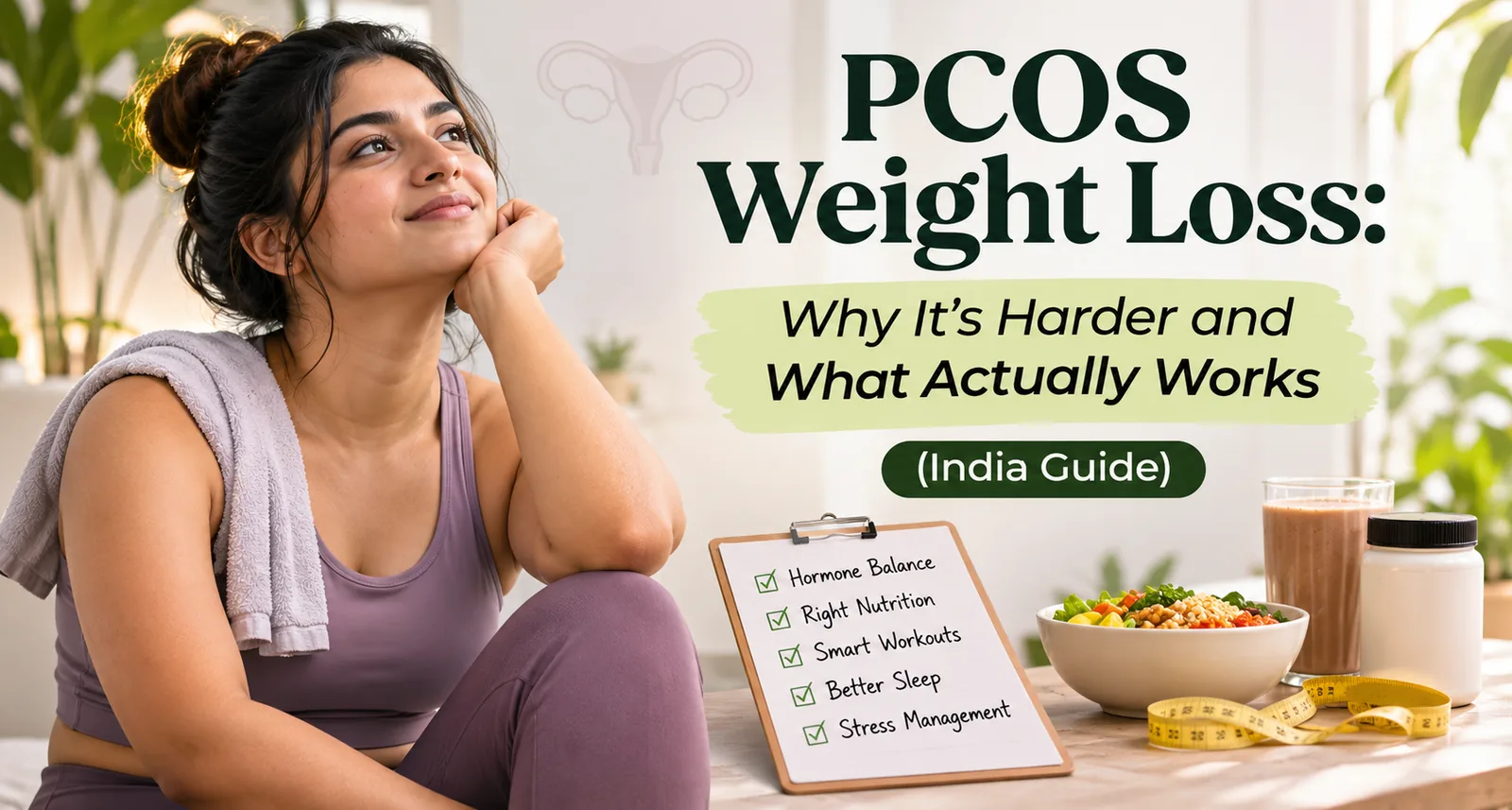
Short answer: PCOS weight loss is absolutely possible, but it often feels slower because many women with PCOS deal with insulin resistance, poor sleep and high stress. What works is simple: aim to lose 5–10% of your body weight, build every meal around protein and fibre, move most days with some strength work, sleep well, and give it 8–12 weeks. No crash diet needed.
If you have PCOS, you have probably heard "just eat less and exercise more" a hundred times. And if you have tried it, you know it doesn't always work the way it does for other people.
This guide explains what is really going on in your body, what the research says, and how to lose weight with PCOS using everyday Indian food. It is a practical guide to PCOS weight loss in India, with no extreme rules and no fake promises.
In this guide: why it's harder · how much to lose · what to eat · exercise · sleep and stress · supplements and medicines · mistakes to avoid · signs of progress · when to see a doctor · FAQs
Why is it harder to lose weight with PCOS?
If the scale refuses to move, it is not a lack of discipline. Women with PCOS tend to gain weight more easily over the years, and researchers are still working out exactly why. So, why is it hard to lose weight with PCOS? A few things seem to pile up together.
Insulin resistance. Many women with PCOS have cells that don't respond well to insulin, so the body makes more of it. High insulin can encourage fat storage, especially around the tummy, and can make you crave sugary or starchy food. This is a big reason behind PCOS belly fat.
Poor sleep and high stress. Short sleep and constant stress raise cortisol, a hormone linked to belly fat and stronger cravings. PCOS also comes with a higher chance of anxiety, low mood and sleep problems like loud snoring, which make healthy routines harder to keep.
Less muscle, more sitting. Muscle helps your body handle sugar. Long hours of sitting can make your insulin response worse.
Here is what is proven and what is still unclear:
| What you often hear | What research shows |
|---|---|
| "PCOS slows your metabolism" | Studies disagree, and any difference looks small. It doesn't explain why a plan fails. |
| "Insulin resistance causes weight gain" | It is common in PCOS and likely plays a part, but it isn't proven as the only cause. Extra weight also worsens insulin resistance. |
| "PCOS makes you hungrier" | Small studies give mixed results. |
| "You can't lose weight with PCOS" | Not true. Lifestyle changes appear to work as well in PCOS as in other women. |
The takeaway: it can be harder, but it is not impossible, and your daily habits still count.
Does weight loss still work with PCOS? How much do you need to lose?
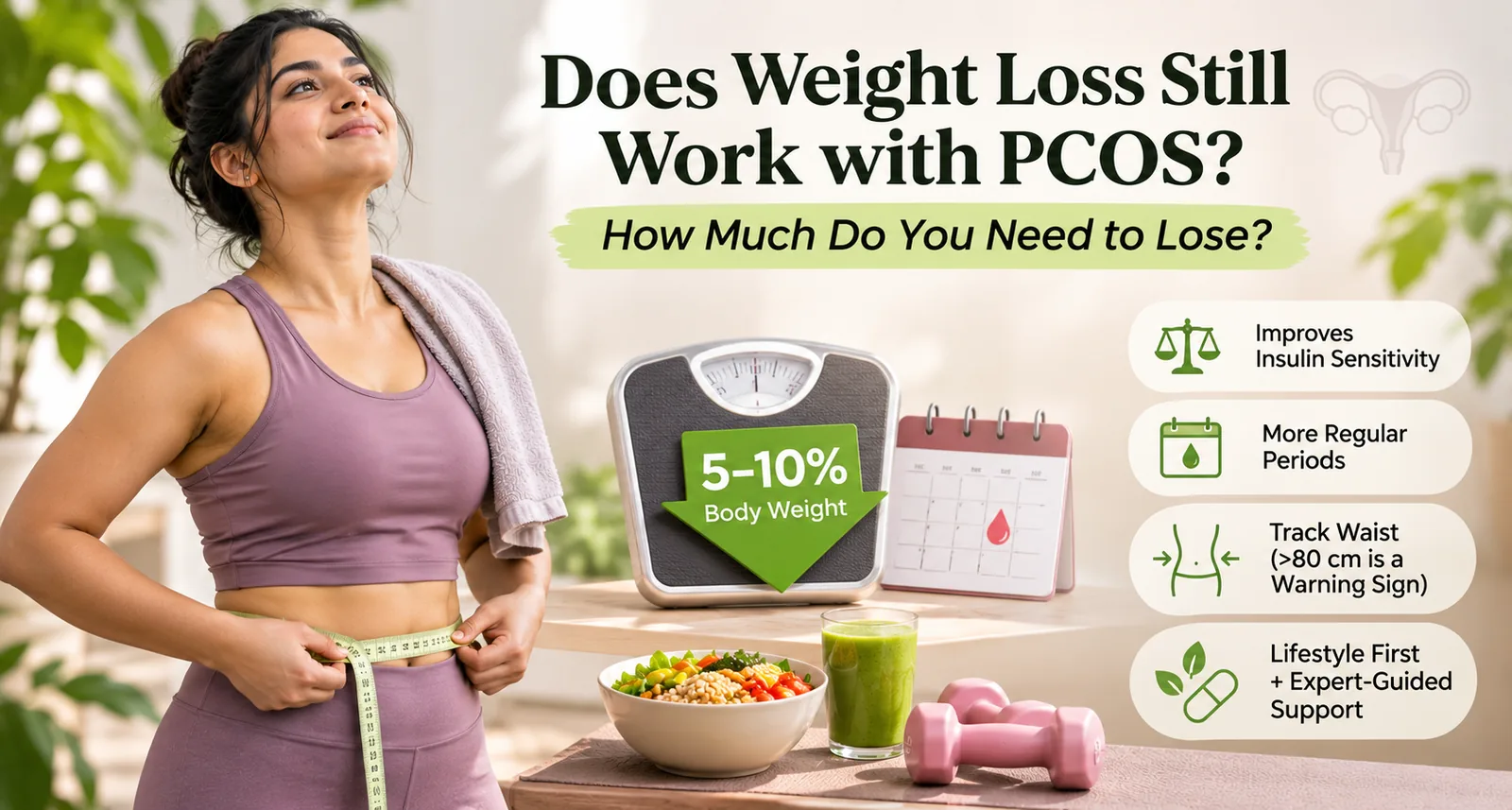
Yes, it does. The 2023 International Evidence-based PCOS Guideline says that healthy lifestyle and weight management, with ongoing support, appears to work as well in PCOS as in the general population. That is why PCOS weight loss is worth your effort, even when progress feels slow.
You also don't need to lose a huge amount. A loss of 5–10% of your body weight can improve insulin resistance and make periods more regular. For a woman weighing 75 kg, that is roughly 4–7.5 kg. A safe pace is about half a kilogram a week, according to ICMR-NIN guidance.
Weight loss won't fix everything. Research hasn't shown a clear effect on unwanted hair growth, for example, so treat it as one part of managing PCOS. Alongside food, movement and sleep, some women also ask their doctor about a women's health supplement to support insulin sensitivity. It is a support, not a shortcut.
Two Indian-specific points. Indian cut-offs are lower than the WHO's: a BMI of 23–24.9 counts as overweight and 25 or more as obese, and a waist above 80 cm in women is a warning sign. So track your waist as well as the scale, because it can shrink even when your weight stays put.
If you have lean PCOS, the goal is not weight loss but healthy habits and avoiding weight gain. You may also hear PCOD, PCOS and now PMOS used for the same condition. The advice here applies to all of them, including PCOD weight loss.
What to eat for PCOS weight loss (the Indian plate)
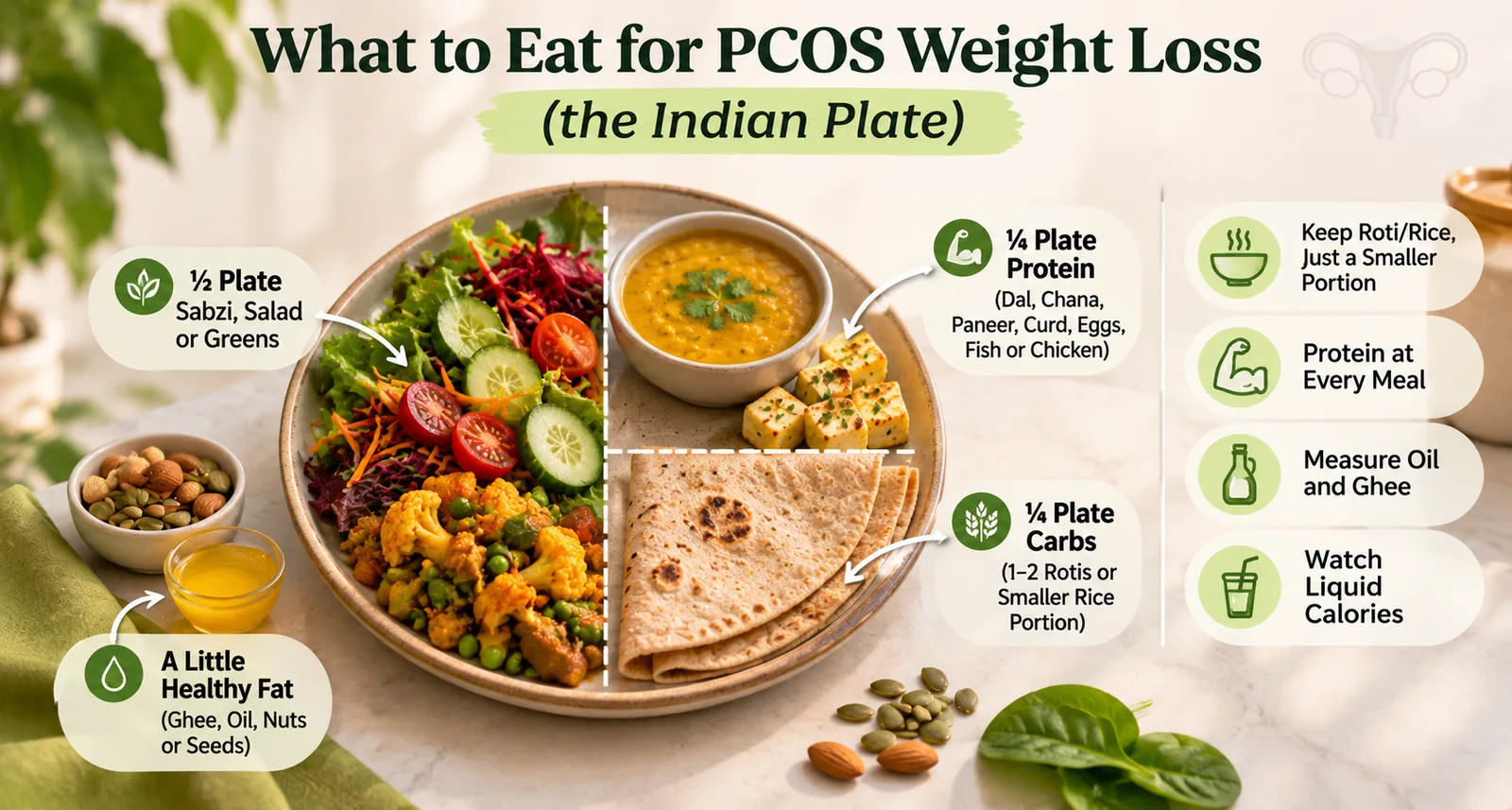
Good news: you don't need keto, expensive "PCOS foods" or to give up roti, rice or dairy. The guideline found no single diet that works better in PCOS. What helps is a small energy deficit using the food you already eat, which is the heart of any PCOS weight loss diet plan Indian families can actually follow.
Try this plate at lunch and dinner:
- Half: sabzi, salad or leafy greens
- One quarter: protein like dal, chana, rajma, paneer, curd, eggs, fish or chicken
- One quarter: carbs like 1–2 rotis (whole wheat, ragi or jowar) or a smaller scoop of rice
- A little healthy fat: a teaspoon of ghee or oil, nuts or seeds
The biggest levers in most homes:
- Shrink the cereal portion, not the meal. Keep your roti or rice, but add more dal and sabzi.
- Protein at every meal. It keeps you full and helps protect muscle while you lose weight.
- Measure oil and ghee for two weeks. Tadka, parathas and pakode add up quickly.
- Watch liquid calories. Sugary chai, packaged juice, biscuits and namkeen add energy without filling you up.
A sample day:
| Meal | Idea |
|---|---|
| Breakfast | 2 besan chillas with mint chutney + a bowl of curd |
| Mid-morning | Roasted chana or a seasonal fruit |
| Lunch | 1–2 rotis, dal, sabzi, salad, curd |
| Evening | Chai with less sugar + a handful of makhana or nuts |
| Dinner | Moong dal khichdi with vegetables, or paneer bhurji with 1 roti |
Want a full week mapped out? See our 7-Day PCOS Diet Plan.
Magnesium-rich foods like pumpkin seeds, almonds, spinach and whole grains are worth adding, and if your diet falls short, Mag Absorb Pro is one option to ask your doctor about. Many women with PCOS also have gut or fatty liver concerns, so a Liver Biome Plus alongside a lower-sugar, higher-fibre plate may be worth discussing too.
Best exercise for PCOS weight loss
The honest answer: the one you will keep doing. The guideline found no type of exercise that beats the others for PCOS.
For weight loss, aim for:
- At least 250 minutes a week of moderate activity, like brisk walking, cycling, dancing or active housework
- Strength exercises on two non-consecutive days, like chair squats, wall push-ups or resistance bands
Muscle helps your insulin sensitivity, so don't rely only on cardio. If 250 minutes sounds like a lot, start smaller. A 10-minute walk after each meal adds up, and some movement is always better than none. Very hard training on too little food can even stop your periods, so build up slowly and take rest days.
Sleep, stress and cortisol
Sleep is part of weight management, not a bonus. Aim for 7–9 hours a night as an adult, keep a regular bedtime, and put screens away an hour before sleep. For stress, small daily habits work better than big plans: a 20-minute walk, deep breathing or journaling.
If you notice loud snoring, daytime sleepiness or low mood, tell your doctor. Treating these can make your weight goals easier to reach.
Supplements and medicines: what the evidence says
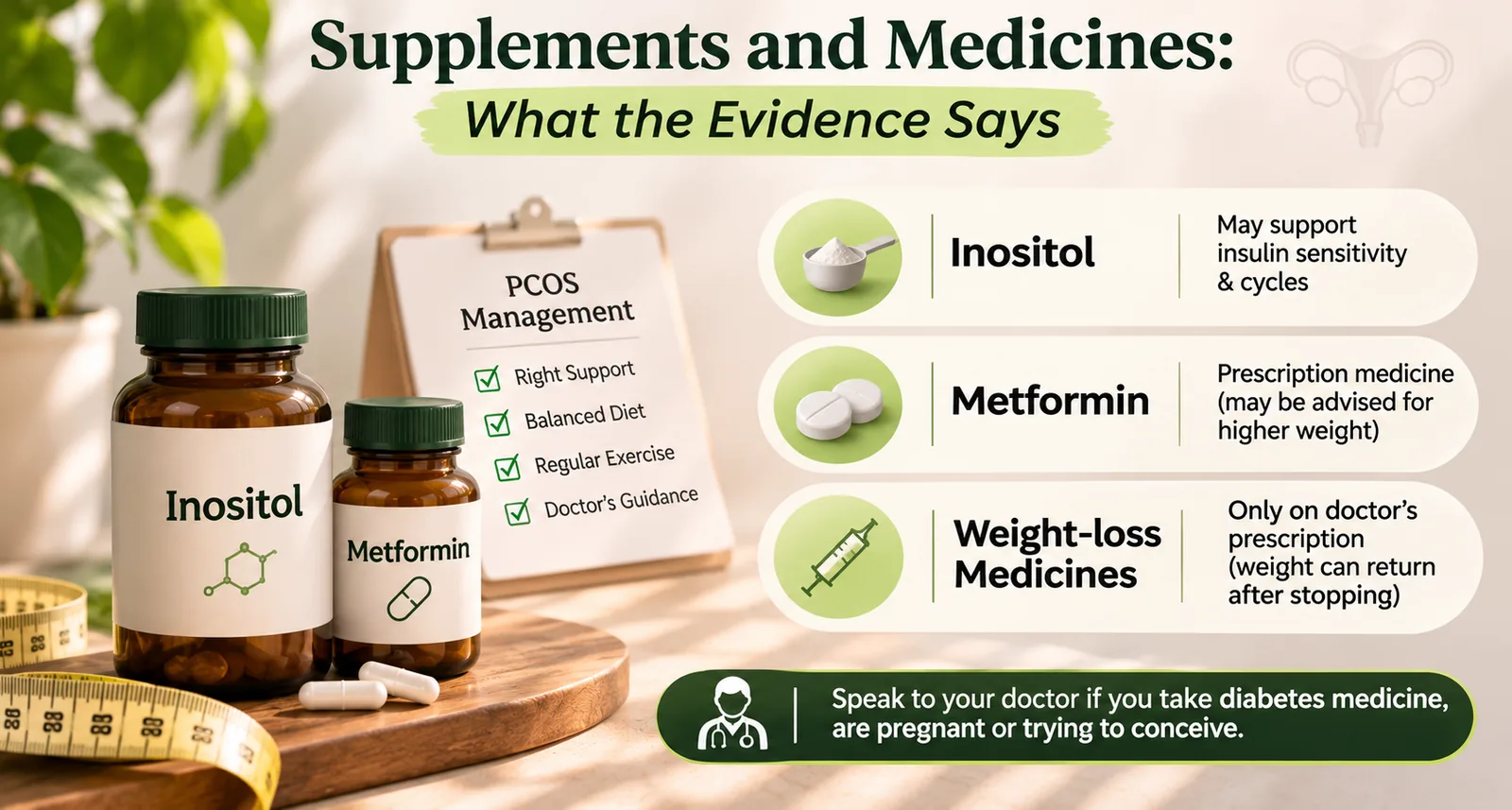
No pill melts fat, and that includes PCOS weight loss supplements. Here is where things stand.
Inositol. Some trials suggest benefits for insulin sensitivity and cycles, but the review behind the 2023 guideline called the evidence for inositol limited and inconclusive. Think of inositol for PCOS weight loss as optional support alongside food and exercise, never a replacement. Our Inositol vs Berberine guide explains the differences.
Metformin. This is a prescription medicine. Doctors may consider it for women at higher weight, mainly for metabolic health. It can lower vitamin B12, so ask about checks.
Weight-loss medicines. Injections and other options are only for a doctor to prescribe, with reliable contraception if pregnancy is possible. Weight often returns after stopping. Never buy slimming products from online sellers.
If you take diabetes medicine, are pregnant or trying to conceive, speak to your doctor before starting any supplement.
PCOS weight loss mistakes to avoid
- Crash dieting. It may show quick results, but it raises stress and the weight usually returns.
- Cutting whole food groups. You don't need to quit roti or dairy.
- Overtraining. Daily intense workouts without rest can backfire.
- Hidden sugars. Juices, flavoured curd and granola bars can spike blood sugar.
- Stacking supplements. More is not better without guidance.
- Comparing yourself to others. Your body works differently, so judge your own progress.
If you skip meals to control weight, binge, or feel fear and guilt around food, please speak to a doctor before dieting.
Signs it's working (even when the scale is slow)
The scale is only one measure. Look out for fewer cravings, steadier energy, less bloating, better mood, a smaller waist and more predictable periods. Most women notice changes within 8–12 weeks, so give your routine time before judging it.
When to see a doctor
Book an appointment if you have:
- No period for three months or more (and you're not pregnant)
- Rapidly worsening facial hair, acne or hair thinning
- Sudden weight gain or no change after a few months of steady effort
- Signs of disordered eating, dizziness or fainting
Your doctor may check thyroid, blood sugar, vitamin D and hormone levels, and can tailor a plan for you.
FAQs

Q1. Why is it so hard to lose weight with PCOS?
Insulin resistance, poor sleep, stress and less muscle can all play a part, though the exact causes aren't fully proven. Steady habits still work.
Q2. Is it harder to lose weight with PCOS?
For many women, yes, it can be slower. But lifestyle changes work about as well as in other women when kept up for months.
Q3. Can you lose weight with PCOS?
Yes. Even a 5–10% loss can improve periods and insulin resistance.
Q4. How much weight loss helps PCOS?
Often 5–10% for women at higher weight. Waist size and metabolic health matter too.
Q5. Does PCOS slow your metabolism?
Probably not by much. Studies disagree, and habits still matter.
Q6. What is the best diet for PCOS weight loss?
There is no single best diet. A balanced plate with protein, fibre and less sugar, using your usual Indian food, is enough.
Q7. Do I have to give up roti or rice?
No. Reduce the portion and add more dal and sabzi.
Q8. Which exercise is best?
The one you will keep doing. Mix brisk walking with strength work on two days a week.
Q9. Does inositol help with weight loss?
It may support insulin sensitivity, but evidence for weight loss is limited. Ask your doctor first.
Q10. Can you do PCOS weight loss in one month?
You may notice fewer cravings, better energy and a smaller waist in a month. A safe pace is about half a kilo a week, so expect roughly 1–2 kg, not more.
Q11. Why do I get belly fat with PCOS?
High insulin, stress and poor sleep encourage fat around the tummy. Strength training, protein and good sleep help.
Q12. Is PCOD weight loss different from PCOS?
The terms are often used interchangeably, and the lifestyle approach is the same.
Final take
PCOS weight loss is not about eating less and punishing yourself. It is about working with your body: steady meals, regular movement, good sleep and patience. Start with one or two small changes this week, like adding protein to breakfast and walking after dinner, and build from there.